Trade Book, Week of May 18: Why We Sold UNH, DIS, LULU, NKE, Trimmed the Semi Winners, Held the Power Names, and Bought Palo Alto
- The Financial View
- May 18
- 10 min read
This week we ran the biggest turnover in the TFV virtual portfolio since we opened it. Four full exits. Three trims. Two holds. Three new positions added. Below is the full trade book, with the thesis behind every single decision, the bull case, the bear case, and the risk that could prove us wrong. A separate deep dive on our top long-term pick is dropping later this week, so the company-level fundamentals there get a lighter touch in this piece. The point of this article is the why behind the book, not the model behind any one ticker.
The honest opening
We are not in the business of selling you a winning streak. The virtual portfolio is up 7.52 percent in two weeks. That is fine, not great, and most of the alpha came from two semiconductor positions that did the heavy lifting while four other names sat there and underperformed the index. A portfolio that has four laggards is a portfolio that is one bad earnings print away from giving back its gains. So we rebuilt it. Cleanly, with a plan, and with rules we will defend on camera if any of these trades go against us.
The trade book at a glance
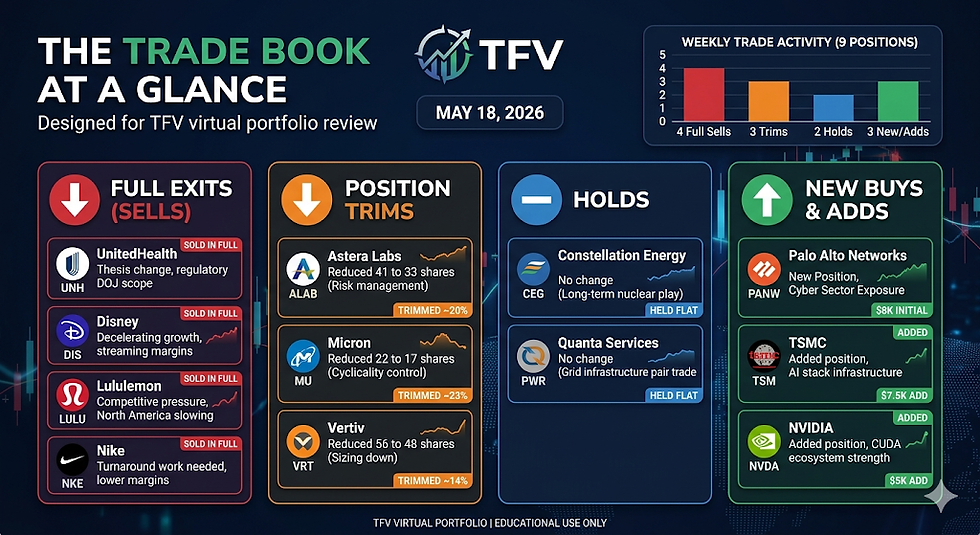
Sells: UNH, DIS, LULU, NKE in full. Trims: ALAB from 41 to 33, MU from 22 to 17, VRT from 56 to 48. Holds: CEG and PWR with no changes. New buys: PANW initial position, TSM add, NVDA add. The cash freed up was roughly 35.5K. Of that, 20.5K went to work in the new and added positions and 15K sat as dry powder. We do not chase. If a setup is not there, cash is a position.
Sell 1: UnitedHealth (UNH)
Thesis change. We did not sell UNH because it dropped. We sold it because the reason we bought it stopped being true. The original thesis was that managed care is a regulated oligopoly with structural pricing power and a Medicare Advantage tailwind. That thesis assumed the regulatory environment was background noise. It is no longer background noise. The DOJ investigation has expanded in scope, and the question is no longer whether UNH faces fines, it is how deeply the business model itself gets reshaped by the outcome. When a thesis pillar fractures, you do not average down, you exit and revisit later with fresh eyes.
Bull case for the people who are staying long. The franchise still does roughly 400 billion in revenue. Optum is a real cash machine. Multiple compression has already done a lot of the damage, so the asymmetry could flip if the probe resolves with a fine and a consent decree rather than a structural breakup. Bear case. Forced divestiture of Optum, multi-year overhang, downward earnings revisions as MA rates get scrutinized. Risk to our exit call. If management cuts a deal in the next 90 days and the multiple snaps back, we miss a 15 to 20 percent rerating. We are willing to miss that. The asymmetric downside is worse than the upside we are walking away from.
Sell 2: Disney (DIS)
DIS was our weakest thesis from day one and we are willing to say that out loud. The pitch was a turnaround story: parks doing the heavy lifting, streaming reaching scale profitability, and the studio rebuilding its hit rate. After two earnings cycles the picture is clearer. Parks growth is decelerating off the post-pandemic surge, streaming margins are improving but not at the pace we modeled, and the studio output is still hit-or-miss. None of that is a disaster. But this is supposed to be the part of the book that compounds. A position that is treading water for two quarters in a bull tape is opportunity cost. We do not pay opportunity cost on conviction we never had in the first place.
Bull case for the holders. Iger has the franchise, ESPN direct-to-consumer is the call option, and the parks complex is irreplaceable IP real estate. Bear case. Streaming is a margin business and the margin curve is flat. Linear TV is bleeding faster than DTC is healing. Risk to our exit. Activists pushing for a sum-of-parts unlock could force a rerating we will miss. Accepted.
Sell 3: Lululemon (LULU)
The bull case on LULU was always that the brand had pricing power that survived consumer downturns. The data is challenging that. Same-store sales in North America are slowing, the men's segment is not scaling at the pace management guided, and competitors at the premium athletic-leisure end are taking share. The international story is real, but the multiple is being asked to underwrite an entire pivot to international growth and a sub-segment expansion at the same time. That is two thesis pillars resting on each other. We prefer single-pillar setups. Bear case is obvious: consumer discretionary slowdown plus competitive intrusion equals a multi-quarter de-rating. Bull case is that the brand is sticky enough and the international ramp is real, so the stock bottoms here and a 50 percent rally is possible from a sentiment trough. Risk we accept by exiting: missing the V-bottom. Risk we avoid: another guide-down.
Sell 4: Nike (NKE)
Same family of problem as LULU but bigger and uglier. The DTC pivot is being walked back. Wholesale channels are being rebuilt at lower margins than the model assumed. China is still a question mark. The new product engine is slower than it should be for a brand of this size. We are not making a permanent call against Nike, we are saying the next 12 months are turnaround work and we would rather own that turnaround at a lower price with proof of execution than pay today's multiple on a promise. Bull case for the holders: management has done this before, the dividend supports the floor, and a fresh product cycle in 2027 is a real catalyst. Bear case: another year of margin pressure and inventory normalization. Risk to our exit: the turnaround inflects faster than we expect and the stock runs 30 percent before we get back in.
Trim 1: Astera Labs (ALAB)
ALAB is the position that did the most work for us. Trimming is not the same as quitting. We cut from 41 shares to 33, which is about a 20 percent reduction. The reason is risk management, not thesis change. ALAB's quarter was a beat above the high end on revenue and a strong guide. The position size had grown beyond the band we set when we sized it originally. When a winner gets too large, you do not pray for it, you take some off, lock in the gain, and let the rest run. Bull case: PCIe Gen 6 ramp, NVLink and CXL adoption, hyperscaler design wins. Bear case: customer concentration, multiple compression if the AI capex narrative wobbles. Risk to the trim: ALAB doubles from here and we wish we had held more. We are fine with that. Trimming a winner has never bankrupted anyone. Letting a winner become 15 percent of a portfolio has.
Trim 2: Micron (MU)
Same logic as ALAB but a different reason. HBM3E is shipping. HBM4 ramp is the next leg. The stock has front-run a lot of that. We cut from 22 to 17 because memory is a deeply cyclical business and we have lived through enough cycles to know the chart can give back six months of gains in three weeks. Bull case: AI-driven memory demand is structurally higher than any prior cycle. Bear case: ASP rollover, CHinese capacity additions, a hyperscaler digestion phase. Risk to the trim: HBM pricing keeps going up and we underowned the move. Acceptable.
Trim 3: Vertiv (VRT)
VRT is the AI infrastructure pick that everyone owns now. That is not a reason to sell, but it is a reason to size down. We went from 56 to 48 shares. The thesis remains intact: liquid cooling, power distribution, and thermal management are the unsexy parts of the data center buildout that compound revenue while the chip names get all the headlines. Bull case: backlog visibility, margin expansion as mix shifts to cooling. Bear case: hyperscaler capex pause, cyclicality in industrial demand. Risk to the trim: AI capex accelerates and VRT does another 40 percent run.
Hold 1: Constellation Energy (CEG)
We are holding CEG flat. The single best long-duration setup we own. Nuclear baseload is the structurally undervalued asset of this decade. The PPAs being signed with hyperscalers are not a 12-month story, they are a 20-year story. Bull case: incremental PPA announcements, capacity payments rising, policy support for nuclear under both political parties. Bear case: regulatory delays on uprates, commodity price exposure on the unhedged portion of the book. Risk to holding: a sharp pullback if the AI power narrative gets repriced. We will buy that pullback, not sell into it.
Hold 2: Quanta Services (PWR)
PWR builds the grid that CEG sells power into. That is the cleanest pair trade we own. Hold flat at 18 shares. Bull case: transmission backlog at record levels, federal grid investment cycle just starting, no real competitor at PWR's scale. Bear case: labor cost inflation, project delays, weather risk. Risk to holding: the position has run a lot and a near-term consolidation is likely. We sit through it.
Buy 1: Palo Alto Networks (PANW), new position
This is the new sector exposure for the book. Cyber. PANW is the dominant platform play in security and the platformization strategy is finally translating into ARR growth that justifies the multiple. We sized in at 8K. Bull case: every enterprise is consolidating cyber spend onto fewer vendors, and PANW is the consolidator. AI-driven threat detection is a wedge product. Bear case: high multiple, sales cycle elongation if IT budgets get pressured. Risk to the entry: a multiple reset in software broadly drags PANW with it regardless of fundamentals. We accept that risk because the structural setup is too good to wait for a perfect entry. A separate deep dive on PANW is in the queue, so we will leave the unit economics for that piece.
Buy 2: TSMC (TSM), add
Adding to TSM at 7.5K. The infrastructure layer of the entire AI stack runs on TSMC fabs. Bull case: 2nm ramp, advanced packaging capacity expansion, structural pricing power as no one else can produce at this node. Bear case: geopolitical tail risk that never goes away, capex intensity weighing on free cash flow conversion in the near term. Risk to the add: a Taiwan headline can take 15 percent off the stock in a session. We size accordingly. This is not a 20 percent position, it is a 7 to 8 percent position with conviction.
Buy 3: NVIDIA (NVDA), add
Adding 5K to NVDA. We know how this sounds. Adding to a name that has already done the move. But this is not 2023. The ramp from Blackwell into the next architecture is the real question and the answer keeps coming back positive. Bull case: software moat through CUDA, ecosystem lock-in, robotics and physical AI as the next vertical. Bear case: customer concentration with the hyperscalers, the eventual end of the capex super-cycle. Risk to the add: NVDA prints a single soft quarter and trades down 20 percent. We sit through it.
What the portfolio looks like now

The book is now concentrated around two themes that we believe in for the next 24 months. AI infrastructure (ALAB, MU, VRT, TSM, NVDA) and the power-and-cyber wrapper around it (CEG, PWR, PANW). Consumer discretionary exposure is at zero. Healthcare exposure is at zero. We accept the concentration risk because the two themes are structural rather than cyclical and because cash at 36 percent of the book is the offset. If the AI trade rolls over for a quarter, we have dry powder to defend the positions and add at better levels.
Stocks we like but did not buy
Honesty section. There are names we wanted to own this week and did not. Marvell. Strong networking story, but PANW and TSM cover the same theme more efficiently. We do not need three semiconductor adds in one week. Eaton. Excellent industrial play on grid build-out, but PWR is already in the book and adding ETN would push utility-adjacent exposure too high. Cloudflare. We love the edge networking thesis, but the valuation is asking us to underwrite a perfect execution that has not yet shown up in the operating margins. We will revisit on a 20 percent pullback. CrowdStrike. Same family as PANW but we picked the platform we judged to have the better consolidation story. Not a knock on CRWD, a choice. We are not buying everything we like. We are buying the best version of each theme we want exposure to.
What we are watching this week
NVDA prints earnings Wednesday after the close. If the quarter is in line and the guide is steady, the trade book holds as is. If the quarter is a beat and raise and the stock gaps up, we will not chase, we will trim a few shares back into strength to keep position size disciplined. If the quarter disappoints, we will add at lower levels. Either outcome is fine. We also watch the cyber tape after PANW's recent print, and we watch credit spreads, because if spreads start widening into June it changes the risk appetite for the whole growth complex.
What would make us wrong
We owe you the failure scenarios. One: AI capex meaningfully slows in the back half of 2026 because hyperscalers digest the buildout. Our entire book is exposed to that. The hedge is cash at 36 percent and the willingness to trim further if the data turns. Two: a Taiwan event. TSM goes to 50 percent of fair value overnight and drags the rest of semis. We size accordingly. Three: a credit event. If the high-yield market cracks, multiples compress everywhere regardless of fundamentals. Cash is the only defense and we are carrying it. Four: we are wrong about the four sells. UNH cuts a deal, DIS gets activist-rerated, LULU bottoms, NKE turns. If three of those four happen at once, we miss a coordinated bounce. Acceptable cost for cleaning up four thesis-broken positions.
Closing
This is a more concentrated book than we have ever run. It is also a cleaner one. Every position now answers a single question: does this name compound capital over the next 24 months at a rate that beats the index after fees and taxes. If the answer is yes, it is in. If the answer becomes no, we will tell you, and we will sell. That is the only consistent rule we operate by. Read the deep dive on our top long-term pick later this week for the full company-level work behind the highest conviction line in this book.
Disclosures. The TFV virtual portfolio is an educational $100K Investopedia account. Nothing in this article is investment advice. Past performance is not indicative of future results. We may hold positions in any of the companies discussed. The Financial View is research-driven media, not a registered investment advisor.


